

City, folding, touring, mountain and cargo e-bikes solve different riding problems. The right choice depends on yours: a long commute, a cramped hallway, rough trails or carrying children and shopping. Match the bike to that daily need before comparing motor power or maximum range.
Key Takeaways
- Match the e-bike to the job: city for paved commutes, folding for compact storage, touring for longer mixed routes, mountain for trails and cargo for passengers or goods.
- Separate storage from carrying: a folding frame saves space, but the complete bike still needs to be manageable when lifted.
-
Check assistance rules: a 250W label alone does not establish ordinary pedelec status; pedalling requirements and assistance cut-off matter too.

How to Categorize Every Type of E-Bikes
Every type of e-bike has two identities: its riding purpose and its legal assistance category. A city bike and a cargo bike can share the same legal category despite looking different.
Riding categories describe the job the bicycle is built to do. They overlap: a touring bike can commute, and a folding bike can have wide tyres. Frame features also need context. A step-through opening makes mounting easier, but does not determine motor performance or trail capability.
Pedelec vs S-Pedelec Rules and Speed Boundaries
The main distinction between a pedelec and an s-pedelec is assisted speed: ordinary pedelecs use the 25 km/h threshold, while speed pedelecs can assist up to 45 km/h and carry additional requirements.
Under EU Regulation 168/2013, Article 2(2)(h), the ordinary pedal-cycle exclusion covers a motor rated at no more than 250W continuous output. Assistance stops when pedalling stops and progressively reduces, cutting off before 25 km/h. You can still travel faster through your own effort or downhill momentum.
National rules govern licensing, insurance, helmets and road access. For example, the Dutch vehicle authority RDW requires speed-pedelec riders to have a moped licence, registration plate, helmet and third-party liability insurance; the minimum age is 16.
Choose using the routes you can legally ride, rather than commute distance alone. PIXAR’s e-bike vs moped guide explains how vehicle category changes everyday ownership.
City E-Bikes for Daily Urban Transit
City e-bikes are designed for paved commutes, shopping and everyday errands. They suit riders who value comfortable posture and easy mounting during frequent stops. Fit matters on these shorter, repeated journeys: our guide to choosing an e-bike frame explains how frame access and riding position affect comfort.
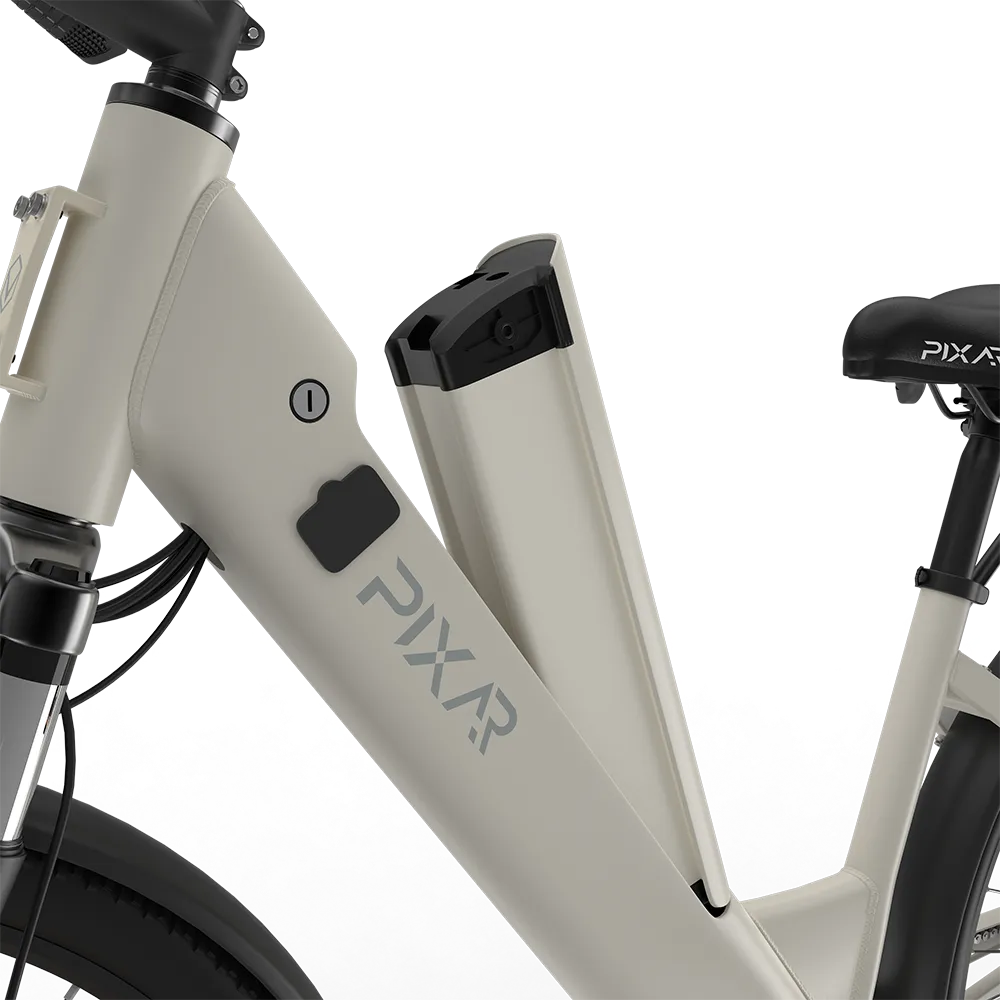
Step-through city frames ease mounting, while lights, mudguards and racks support daily travel. The PIXAR C1 combines a low-step frame with a removable 36V 13Ah battery; the PIXAR C1 Pro adds a 36V 18Ah Samsung battery and hydraulic disc brakes. This city-focused equipment prioritises road practicality, with less emphasis on the suspension and traction needed for technical trails.
Before you buy: Check saddle height, handlebar reach and low-speed control, then assess your steepest regular climb and the equipment needed for your commute.

Folding E-Bikes for Compact Storage and Portability
Folding e-bikes are designed to occupy less space when stored or transported. They suit smaller homes, car journeys and train connections where the operator permits them as luggage. The practical benefit is bringing your bicycle into spaces that cannot accommodate its full riding length, such as a cupboard or car boot.
A folding e-bike’s hinged frame and compact wheels reduce its storage footprint, although complete bike weight still determines how manageable lifting feels. The PIXAR Rusher combines 20-inch wheels and front suspension with folded dimensions of 85 × 33 × 75 cm. Tyre width and pressure also affect comfort on uneven streets; our 20 vs 27.5 vs 29-inch wheel guide explains how compact packaging changes the ride.
Before you buy: Measure your storage space and try folding, securing and lifting the complete bike; for train journeys, check the operator’s dimensions and battery requirements.

Touring E-Bikes for Long-Distance Adventures
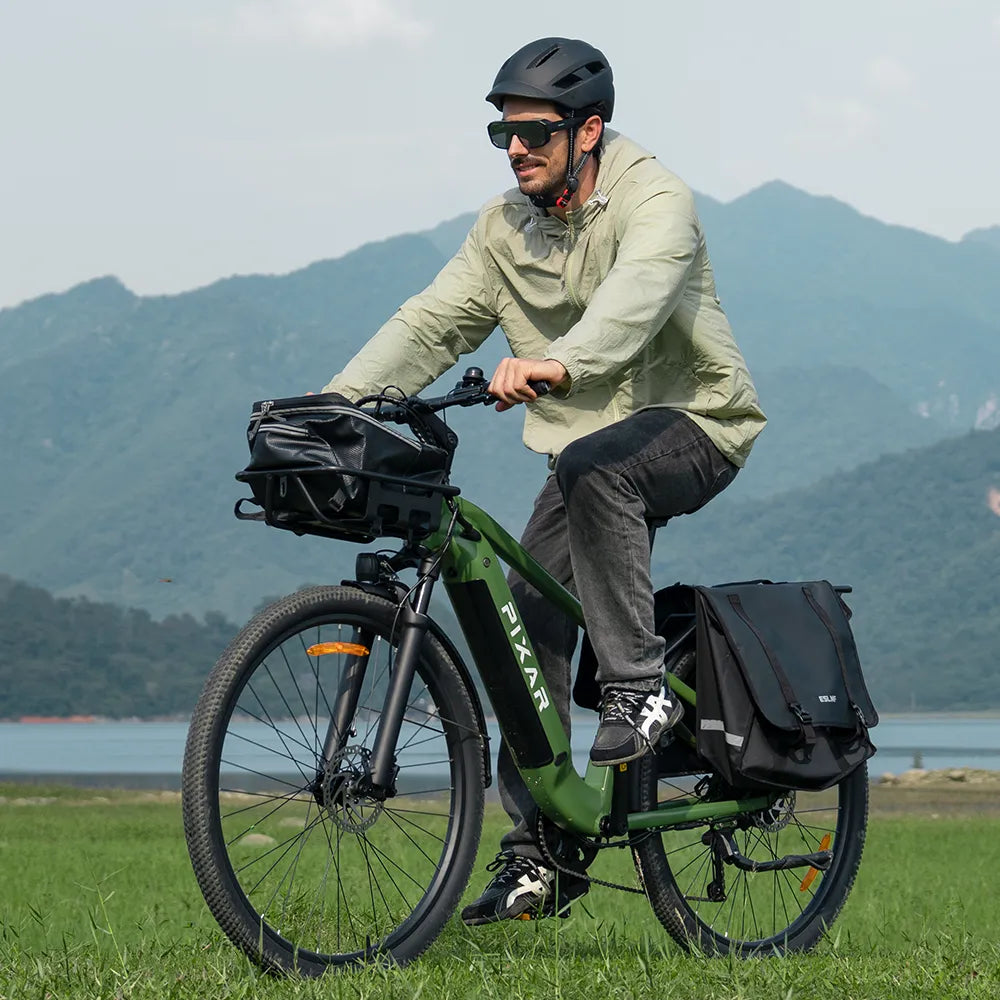
Touring e-bikes are designed for longer journeys across paved roads, maintained gravel and firm country tracks. They suit extended commutes, weekend exploration and trips with luggage. Comfort needs to last beyond a short ride, while battery planning must account for the distance between charging opportunities. Our electric bike range guide explains the main variables.
Larger wheels, suitable gearing and luggage compatibility help touring bikes cover changing surfaces with equipment aboard. The PIXAR Largo E-bike combines 29-inch tyres, front suspension and torque sensing with a 36V 15.8Ah Samsung battery of approximately 569 Wh. Its stated maximum range is up to 140 km; hills, load, temperature and assistance level can reduce the distance available.
Before you buy: Check comfort over a longer ride, rack and total weight limits, clearance for panniers beside the rack, and charging access along your intended route.

Mountain E-Bikes for Rugged Off-Road Trails
Mountain e-bikes are designed for off-road riding where rough surfaces, steep climbs and repeated impacts demand control. They suit riders who regularly use trails and need equipment matched to that terrain. The relevant comparison is how the complete bike climbs, grips and descends, rather than its maximum motor torque alone.
Mountain e-bike geometry, grippy tyres and suspension work together to manage uneven ground. A hardtail has front suspension and a rigid rear frame, offering a simpler setup for smoother tracks; a full-suspension eMTB adds a rear shock for rougher terrain. The extra suspension needs maintenance, while aggressive trail tyres can add rolling resistance and noise on paved commutes. These trade-offs matter when most of your riding is on roads.
Before you buy: Match suspension, low gears and brakes to your actual trails, and consider how often you will use that capability during everyday riding.
Cargo E-Bikes for Heavy Loads and Family Utility
Cargo e-bikes are designed to carry passengers or goods in dedicated load areas. They suit school runs, larger shopping trips and deliveries that exceed the intended use of a conventional commuter rack. Choose the layout around what you carry most often, as well as the entrances, parking spaces and turns on your regular route.
Longtail cargo e-bikes extend the rear carrying area for compatible seating or luggage; front-loaders, often called bakfiets or Long John bikes, place a box ahead of the rider. That carrying space increases storage and manoeuvring demands. Maximum gross vehicle weight includes the bike, rider, accessories, passengers and cargo, with separate rack limits also applying. A quoted total limit therefore cannot be treated as the weight of goods you can add.
Before you buy: Confirm load limits and approved passenger equipment, including seats, handholds, foot supports and wheel protection; test loaded starts, stopping and the parking stand.
Types of E-Bike Motors and Mechanical Drive Systems
The main types of e-bike motors are mid-drive and wheel-hub motors. Motor location determines how assistance reaches the road; sensors and controller settings influence how it feels.
A mid-drive sits near the cranks and sends power through the chain or belt and the bicycle’s gears. Lower gears help on slow, demanding climbs, although motor force also passes through drivetrain components that need inspection and maintenance.
A rear-hub motor assists at the back wheel without sending its output through the chain. It can suit everyday road riding, while the chain, brakes, bearings and electrical connections still require care. Our hub motor vs mid-drive comparison explains the practical differences.
Cadence sensors detect pedal rotation; torque sensors measure pedalling force. The Largo combines torque sensing with a rear-hub motor, showing that this feature is not exclusive to mid-drives. See our torque sensor vs cadence sensor guide for a closer comparison of starting, climbing and low-speed control.
Which Type of E-Bikes Matches Your Lifestyle Best
Choose your type of e-bike by checking terrain, storage and carrying needs in that order. Use the comparison below to shortlist a category, then test the constraint most likely to cause difficulty.
| E-bike type | Main use | Most useful checks |
|---|---|---|
| City | Paved daily journeys | Fit, lights and rack |
| Folding | Compact storage | Folded size and lifting |
| Touring | Longer mixed routes | Comfort, range and luggage |
| Mountain | Off-road trails | Suspension and traction |
| Cargo | Passengers or goods | Load limits and handling |
For example, try carrying a folding bike through your actual entrance or starting a touring bike with loaded panniers. Those checks reveal more about daily suitability than an isolated motor or battery number. When two categories fit, favour the one that handles your most frequent journey comfortably.
Final Words
Choose the e-bike category that solves your daily transport needs, then confirm fit, handling, load limits and charging access. At PIXAR, we recommend checking the complete journey before comparing headline specifications: the right bike should work as well in your hallway and at your destination as it does on the road.
Frequently Asked Questions (FAQ)
What is the main difference between an e-bike and a pedelec?
A pedelec provides motor assistance in response to pedalling; “e-bike” is a broader everyday term. The ordinary EU category discussed here has a 250W continuous motor limit and assistance cut-off at the 25 km/h threshold.
What is the primary difference between a city e-bike and a touring e-bike?
City e-bikes prioritise everyday comfort on paved roads. Touring e-bikes focus on longer rides and mixed surfaces, so luggage compatibility, sustained comfort and charging plans become more important.
Do cargo e-bikes require a special driving license or road registration?
A compliant ordinary pedal-assist cargo bike follows bicycle rules in the Netherlands. Check your country and the exact assistance configuration, since speed-pedelec or throttle-powered versions can fall into different categories.
Can you ride a mountain e-bike on normal paved city roads?
A mountain e-bike can use paved roads when its equipment and assistance system meet local requirements. Aggressive trail tyres may add noise and rolling resistance, making touring tyres more practical for mainly road-based use.