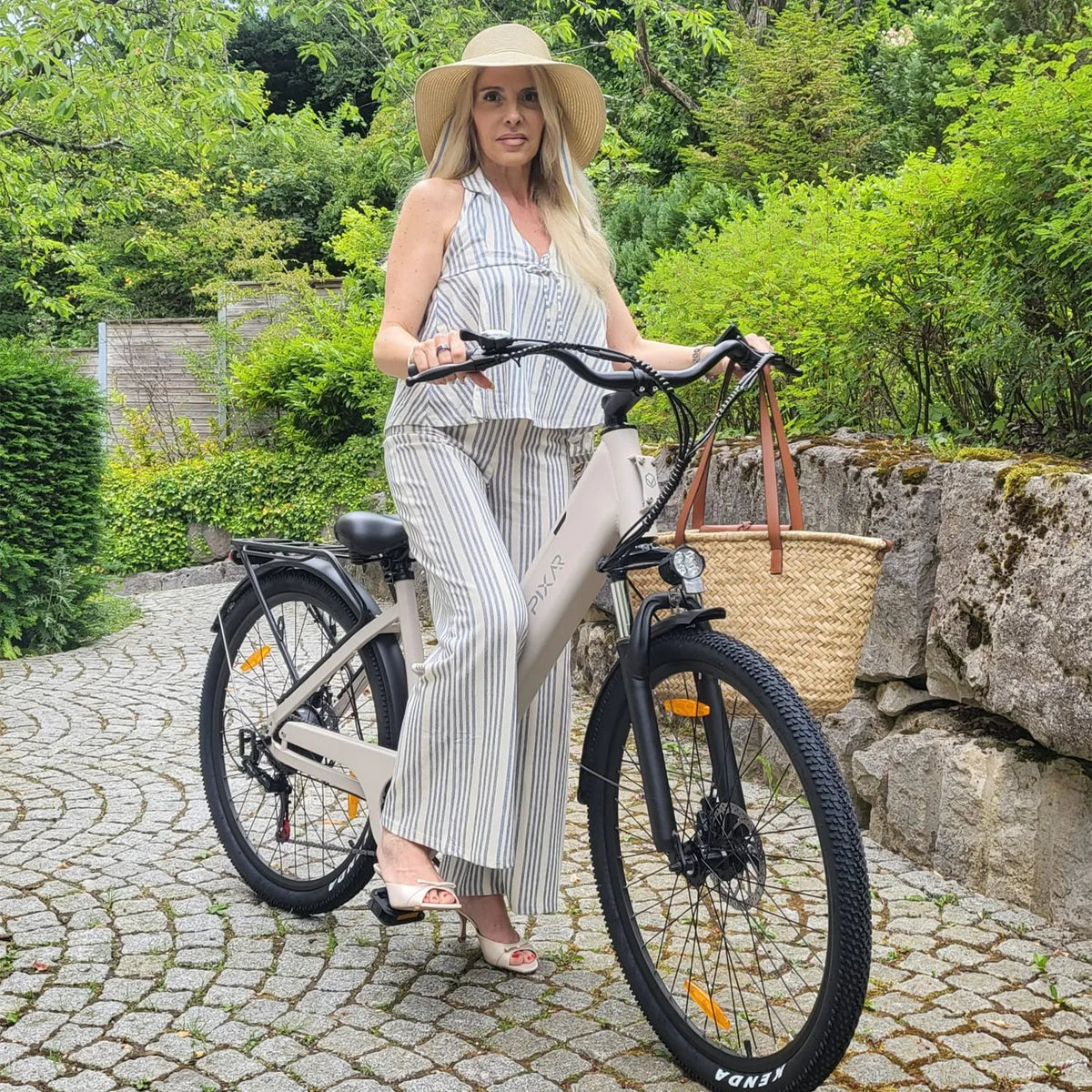


Short women usually know within the first few metres. If stopping means sliding sideways off the saddle and reaching for the kerb with one toe while the bike leans away from you, the size is wrong, and no amount of motor assistance corrects it.
Most advice on choosing an electric bike for short women stops at two words: step-through. That describes a frame shape. It is not a measurement, and it tells you nothing about whether you can put a foot down at a junction or drop the saddle far enough to pedal properly.
This guide works from two numbers you can check before you order: standover height and minimum saddle height. It covers how to measure your own inseam, what those figures should be for a rider around 150 cm tall, what wheel diameter does and does not change, and which parts of a poor fit can still be corrected after the bike arrives.
4 Measurements That Decide Fit on an Electric Bike for Short Women
Four measurable quantities decide whether an electric bike for short women fits: standover height, minimum saddle height, reach to the handlebars, and net weight. Motor output, battery capacity, and stated range only become relevant once a bike passes all four.
The reason is that the hardest moments for a shorter rider happen at or below walking pace. Pulling away from a junction, stopping on a camber, and manoeuvring in a bike store are all situations where the motor contributes nothing and the mass of the bike works against you rather than with you.
Motor specifications cannot break the tie between one electric bike and another. Under Regulation (EU) No 168/2013, a pedal-assisted bicycle is excluded from motor-vehicle type approval only where its maximum continuous rated power stays at or below 250 W. Motor output must also cut off when the rider stops pedalling, and be progressively reduced and cut off before 25 km/h, limits reflected in the EPAC standard EN 15194.
Those two figures are close to identical across the category, which is precisely why they tell you nothing about whether a given electric bike suits a short woman.
Use these four as your comparison structure:
- Standover height — the height of the frame at the point where you straddle it, measured from the ground.
- Minimum saddle height — the lowest riding position the seatpost will allow.
- Reach — how far forward you extend to hold the handlebars.
- Net weight — what you handle when pushing, parking, or lifting the bike.
A step-through label narrows the shortlist without deciding it. The label confirms that the top tube is low or absent; it does not say how low, and low is a number rather than a category. The same ordering applies to city riding generally, where getting fit and control right comes before comparing features.

Standover Height and Minimum Saddle Height on a Low Seat Height Electric Bike
Clearing the frame and pedalling properly are two separate tests, and a bike can pass the first while failing the second. This is the failure mode that most sizing advice for shorter riders leaves out.
Standover height is the vertical distance from the ground to the top of the frame at the point where you straddle it. Passing this test means a shorter rider can stand over the bike flat-footed, with both feet down and the bike upright rather than tilted towards you.
Minimum saddle height is the lowest the saddle top can sit above the ground on a given e-bike, once the seatpost is pushed as far into the frame as the manufacturer allows. It is limited by seat tube length and by the minimum insertion depth marked on the post, which is a safety limit and not a suggestion.
For a petite rider this is the figure that decides whether a comfortable pedalling position is reachable at all.
The two limits come apart more often than a shorter rider would expect. A frame can have a deeply dropped opening, which passes the standover test, while still using a seat tube long enough that the saddle cannot come down to a height you can pedal from.
Consequently, a low seat height electric bike is only genuinely low if both figures are low. A bike you can comfortably stand over may still leave you reaching for the pedals at the bottom of each stroke.
Can a ebike pass the standover test and still be too tall? Yes. Standover height is set by the frame opening while minimum saddle height is set by seat tube length, so a deeply dropped frame can still hold the saddle above the position a shorter rider needs. Check both figures rather than either one alone.
The same separation matters for older riders, and the PIXAR guide to e-bikes for women over 60 treats standover clearance and minimum saddle height as two independent measurements for the same reason.

Electric Bike Sizing for Short Women, Starting From Your Inseam
Electric bike sizing for short women starts with a single inseam measurement, which produces both thresholds, so it is worth taking carefully rather than estimating from trouser size.
- Stand against a wall in the shoes you would ride in, heels touching the skirting.
- Place your feet about 15 cm apart, as they would be either side of a frame.
- Pull a hardcover book up between your legs, spine upwards, until it sits firmly against your crotch.
- Hold the book level and mark the wall at its top edge.
- Measure from that mark to the floor in centimetres. Take the measurement twice, and if the two differ, use the smaller figure, which keeps the standover margin conservative.
Threshold one, for standover:
the published standover height should be at least 2 cm below your inseam. For an inseam of 70 cm, that puts the ceiling at 68 cm. The margin exists so that an unplanned stop does not end with the frame catching a shorter rider mid-dismount.
Threshold two, for saddle height:
multiply your inseam by 0.883 to get a starting saddle height measured from the centre of the bottom bracket to the top of the saddle. An inseam of 70 cm gives roughly 61.8 cm, which is the figure to compare against any low seat height electric bike on your shortlist.
This is a long-standing bike fit convention, commonly called the LeMond method, rather than a research finding.
That convention exists to land the knee at an angle the cycling literature associates with efficient pedalling, which is why e-bike sizing cannot stop at standover height.
Peveler and Green, writing in the Journal of Strength and Conditioning Research in 2011, compared saddle heights set by knee angle against a height set at 109% of inseam measured from floor to ischium. They concluded that “use of 25° knee angle appears to provide optimal performance while keeping knee angle within the recommended range for injury prevention.” Their paper describes a 25 to 35 degree knee angle as the range recommended for injury prevention.
Two limits apply before borrowing those figures. The study tested 11 well-trained male cyclists rather than shorter riders on assisted bikes, so the angles indicate a target zone rather than a personalised prescription.
The inseam method it compared against, 109% measured from the floor, is also a different calculation from the 0.883 convention above, so the result neither validates nor rules out the formula you started with.
One conversion problem catches people out. Manufacturers usually publish seat height measured from the ground, while the 0.883 figure is measured from the bottom bracket, so the two numbers are not directly comparable.
The practical workaround, and the one most useful to a short woman buying online, is to measure the ground-to-saddle-top height on a bike you already ride comfortably and compare that figure against the published minimum.
Target Numbers for an E-Bike for Women Around 150 cm Tall
An e-bike for women around 150 cm tall has to be chosen on inseam rather than on stature, because two riders who both stand 150 cm can differ by several centimetres in leg length. The table converts four common inseam measurements into the two figures worth comparing against a product page.
| Your inseam | Max standover | Saddle height target |
|---|---|---|
| 66 cm | 64 cm | about 58 cm |
| 68 cm | 66 cm | 60 cm |
| 70 cm | 68 cm | about 62 cm |
| 72 cm | 70 cm | about 64 cm |
Saddle height targets are measured from the bottom bracket, and the standover column applies the 2 cm margin from the previous section. Work from the row closest to your own measurement rather than estimating a row from your height.
For context on why standard frames so often miss a short woman, Our World in Data, drawing on the NCD Risk Factor Collaboration, puts the global average height of adult women born in 1996 at 159 cm. The same source notes that the tallest women are found in Europe and Central Asia.
A rider at 150 cm therefore sits well below the global figure, and below a European average that the same source describes as among the highest in the world. That gap is the reason bikes built around an average European frame size tend to run tall.
One current listing shows what published geometry looks like on an e-bike for petite women. PIXAR lists the Rusher with a standover height of 51 cm, a minimum seat height of 72 cm, a maximum seat height of 115 cm, and a recommended rider height range of 150 to 200 cm.
Against the table above, a 51 cm standover sits 13 cm below the ceiling for even the shortest inseam listed, which is a wide margin rather than a marginal pass.
That said, a recommended height range spanning 50 cm is a broad manufacturer claim covering both ends of a market, and for a short woman it is not a substitute for checking your own inseam against the two thresholds. Use the published geometry, not the recommendation, as your evidence.
Wheel Diameter Versus Frame Geometry on an E-Bike for Petite Women
Wheel diameter influences overall bike height indirectly, but standover height is set by frame geometry, so the two should not be treated as interchangeable. Advice that tells petite riders to buy the smallest wheels available is substituting a proxy for the measurement that actually matters.
Small-wheel folding bikes are designed primarily to reduce folded volume, and the low frame line that often comes with them is a by-product of that goal rather than a sizing feature. In contrast, a full-size city bike built on a deeply dropped step-through frame can produce a standover height as low as, or lower than, a small-wheel model with a conventional frame.
The comparison to run is therefore between published standover figures, not between wheel formats, whatever a listing claims about small wheels suiting petite riders. Once two bikes both clear your threshold, wheel diameter becomes a question about ride feel, storage, and where you will keep the bike, which is a different decision from whether it fits.
Do smaller wheels lower the standover height? Not reliably. Standover height is a frame design decision, so a small-wheel bike can measure higher at the frame opening than a full-size step-through built with a deeply dropped frame. Compare the published standover figures instead of inferring them from wheel format.
Handlebar Reach on a Step-Through E-Bike for Short Women
Reach is the third failure point for shorter riders and the one least likely to appear on a product page. It describes how far forward you extend to hold the handlebars, and it decides whether the riding position stays comfortable over a full trip rather than only in the first few minutes.
On a step-through e-bike for short women, reach deserves more attention than it usually gets, because the low frame opening that makes mounting easy says nothing about how far away the bars sit. The two dimensions are governed by different tubes.
The check is straightforward once you are on the bike. With your hands on the grips, your elbows should stay slightly bent and your shoulders relaxed. If you have to lock out your arms, round your back, or slide forward on the saddle to hold the bars, the reach is too long for a shorter rider no matter how well the bike scored on standover height.
Most manufacturers publish handlebar height and stop there, which leaves petite riders without the one dimension that decides the cockpit. PIXAR lists a handlebar height of 127 cm for the Rusher, for example, which describes the upright position but not the distance forward, and neither reach nor effective top tube length appears on that product page.
Where reach is missing, ask for it directly before ordering, because it is the number a shop fitting would check first.
Electric Bike Weight and Low Speed Handling for Short Women
A low saddle solves getting on the bike. The weight of the bike decides everything that happens when a short woman is not riding it, and the two problems have different solutions.
Pushing the bike across a car park, holding it upright on a slope, reversing it out of a bike store, and lifting it over a kerb are all handled with your arms and your body weight rather than the motor.
A rider who is shorter is often also lighter, which reduces the leverage available for holding a heavy bike upright when it starts to lean. This is the part of choosing an electric bike for short women that no specification table answers on its own.
PIXAR publishes a net weight of 26.1 kg for the Rusher, with unfolded dimensions of 172 × 66 × 116 cm and folded dimensions of 84 × 51 × 79 cm. Measure the folded figures against the boot, lift, or cupboard you have in mind, and treat the 26.1 kg as the separate question of whether a shorter rider can raise the bike into that space.
Folding reduces volume and not mass, which is the distinction that matters most to a petite rider. A folded bike still weighs what it weighed before, so the fold answers a storage question while leaving the lifting question exactly where it was. This is part of the wider point that a bike behaves differently once the motor is off.
Where the battery is removable, taking it out before moving the bike lowers what you actually lift, and that is worth asking about with a confirmed battery weight rather than an estimate.
Five Numbers to Ask For Before Ordering an Electric Bike for Short Women
These five figures let you exclude most poorly fitting bikes without a test ride, which matters whenever an electric bike for short women has to be chosen from a product page alone. Ask for all of them in one message and treat vague answers as a warning sign in itself.
| Number to request | Why it decides fit |
|---|---|
| Standover height | Whether you clear the frame |
| Minimum saddle height | Whether you can pedal properly |
| Reach or top tube length | Whether you overstretch |
| Crank length | Sets the pedal circle size |
| Net weight of the bike | What you push, park, and lift |
A usable request reads like this: “Please confirm, in centimetres, the standover height, the minimum saddle height measured from the ground, the reach or effective top tube length, the crank length, and the net weight of the assembled bike.”
Availability varies more than it should, and shorter riders feel the gap most. The Rusher product page publishes three of the five, listing standover height, minimum and maximum seat height, and net weight, while reach and crank length still need to be requested. Where a seller answers with a rider height range instead of measurements, ask again, because a height range is a recommendation rather than a dimension.
What if a seller will not give the measurements? Treat it as a reason to hesitate. A seller who cannot state standover height and minimum saddle height in centimetres for a bike you cannot try in person is asking you to accept fit on trust. For a short woman buying unseen, a listing that publishes the geometry is the lower risk purchase.
Adjustments for an E-Bike for Petite Women That Almost Fits
On an e-bike for petite women, reach and pedalling stroke can be adjusted after purchase. Standover height cannot, and neither can a minimum saddle height that sits above the position you need.
Four changes are worth pricing before a petite rider rejects an otherwise suitable bike:
- A shorter stem pulls the handlebars back towards you.
- Handlebars with more sweep bring the grips closer without changing the stem.
- A seatpost with less setback moves the saddle forward over the pedals.
- Shorter cranks reduce how far the knee travels at the top of the stroke, which tends to matter more for a shorter inseam.
Two problems have no fix for a shorter rider. If the standover height is above your inseam, the frame is wrong for you and no component change alters the geometry. If the minimum saddle height sits above your target riding height, you will ride with the saddle at its lowest setting and still be too high.
Before ordering parts, confirm with the seller that a stem or bar change will not leave brake and gear cables too short, and check whether the work affects the warranty. On an e-bike there is usually also a display or control cable routed through the cockpit, which can restrict how far components can move.
Frequently Asked Questions
What size e-bike is best for short women?
The right size for a short woman is the one that clears two thresholds rather than one carrying a particular frame label: a standover height at least 2 cm below your inseam, and a minimum saddle height low enough to reach your riding position. Frame style and wheel format only narrow the shortlist.
Are smaller wheels better for short women?
Not by themselves. Standover height is set by frame geometry rather than by wheel diameter, so compare the published standover figures instead of the wheel format.
Can a woman of 150 cm ride a folding e-bike?
Yes, provided the published standover height clears your inseam ceiling. PIXAR lists the Rusher with a standover height of 51 cm, a minimum seat height of 72 cm, and a recommended rider height range starting at 150 cm, though net weight still needs checking separately because folding reduces volume rather than mass.
How do I measure my inseam for an e-bike?
Stand against a wall in riding shoes, pull a hardcover book up firmly between your legs, and measure from the top edge of the book to the floor in centimetres. Measure twice and use the smaller result, which keeps your standover margin conservative.
The Bottom Line
Choosing an electric bike for short women comes down to two measurements and one habit. The measurements are standover height, which should sit at least 2 cm below your inseam, and minimum saddle height, which has to leave room for the riding position your inseam implies.
The habit is asking for figures in centimetres before you order, including reach and net weight, and declining to accept a recommended height range as a substitute.
Where those figures are published, the decision becomes checkable rather than speculative. The Rusher’s listed standover height of 51 cm settles the first threshold at home, while its 72 cm minimum seat height needs the ground-referenced comparison described above, because bottom bracket height is not published. Those are the kinds of figures any seller of an e-bike for petite women should be able to give you before you order.