

For most city riding, a well-chosen 7-speed drivetrain provides enough range for starts, cruising and moderate hills. A 9-speed system becomes more useful on longer climbs, changing gradients and mixed-surface touring.
More gears do not make an electric bike faster by themselves. What matters is whether the available ratios suit your route and let you pedal comfortably while the motor provides assistance.
How do gears work on an electric bike?
Many electric bikes combine mechanical bicycle gears with electrical assistance levels. The gears change the relationship between your pedalling and the rear wheel; the assistance level changes how much help the motor is asked to provide.
| Control | What it changes | When to adjust it |
|---|---|---|
| Mechanical gear | How hard the pedals feel and how far the bike moves per pedal turn | Before a hill, after slowing down, or when your pedalling feels too heavy or too fast |
| Pedal-assist level | The amount of motor support requested within the bike’s settings and limits | When you want more or less electrical help |
A low or easy gear makes the pedals lighter to turn and is useful for setting off, climbing and riding slowly with control. On a derailleur bike, this normally places the chain on a larger rear sprocket. A high or hard gear adds resistance and moves the bike farther per pedal revolution, making it suitable for faster riding on level ground.
Use pedal feel rather than relying only on the number shown on the shifter. If the pedals feel difficult to turn, choose an easier gear. If they spin quickly with little resistance, move to a harder gear. A high assistance setting does not replace shifting. Our guide to how pedal assist works explains how the sensor, controller, battery and motor respond while you ride.

7-speed vs 9-speed e-bike: which should you choose?
| Comparison | 7-speed drivetrain | 9-speed drivetrain |
|---|---|---|
| Best suited to | City riding, commuting and regular leisure trips | Touring, longer mixed routes and frequently changing gradients |
| Riding feel | Clear, practical changes between ratios | More choice for fine-tuning pedalling rhythm |
| Most useful when | The route is flat to moderately hilly and the lowest gear suits your climbs | You want smaller steps, a wider range, or both, as confirmed by the drivetrain specification |
| What the count does not prove | Top speed, climbing ability, gear range, motor power or overall bike quality | |
Seven gears are enough for many commuters because they cover starts, normal cruising and moderate changes in elevation without requiring constant small adjustments. A 9-speed drivetrain is worth considering when your route repeatedly changes between level ground and climbs, you carry luggage, or you want to hold a steadier pedalling rhythm over longer distances.
The two extra positions are useful only if the complete setup gives you ratios you will use. A suitable 7-speed city bike can be a better choice than a 9-speed bike whose gearing and design are aimed at a different type of journey.
Why gear range matters more than the number alone
A rear gear specification such as 14–28T describes the smallest and largest sprockets; T means teeth. With the same front chainring and wheel, a larger rear sprocket creates an easier climbing gear, while a smaller rear sprocket creates a harder gear for covering more distance with each pedal turn.
Gear count tells you how many positions are available, but not how easy the easiest gear is or how large the steps are between ratios. Check the rear sprocket range together with the front chainring and wheel size. A system with more gears may offer a wider range, closer steps or a mixture of both.
For example, PIXAR currently lists a 14–28T 7-speed system for the C1 and C1 Pro. Largo uses an 11–32T 9-speed system with a different front chainring and larger wheels. These complete systems also differ in tyres, motor response and intended use, so the sprocket numbers should not be turned into a simple speed comparison.
Do you need more gears for hills?
You need a sufficiently easy gear for the hills you actually ride, not necessarily the largest possible number of gears. A larger rear sprocket can reduce the pedal force required at a given speed, while additional ratios can help you adjust your pedalling rhythm as the gradient changes.
Shift into an easier gear before the climb becomes steep. Waiting until the pedals are already difficult to turn places more load on the chain and makes a smooth shift harder. Once you are in a comfortable mechanical gear, add only the level of assistance you need.
Motor torque also affects starts and climbs, but extra Nm does not replace suitable gearing. Our guide to how much e-bike torque you need explains how terrain, total weight and rider effort affect that decision.
How do gears interact with the motor and battery?
Mechanical gears remain useful when assistance is low, the battery is depleted or the route changes. On a rear hub e-bike, the motor turns the wheel independently of the bicycle chain and rear sprockets, so shifting changes your pedalling effort rather than the motor’s operating ratio. A mid-drive sends rider and motor force through the bicycle drivetrain, making gear choice important to both.
Good gear choice can help you maintain a steady pedalling rhythm, but it does not guarantee a specific improvement in battery range. Assistance level, hills, speed, wind, temperature, stops, tyre pressure and total weight also affect energy use. See our hub motor vs mid-drive comparison for a fuller explanation of the two systems.
How should you shift gears on an e-bike?
- Choose an easier gear before stopping or climbing. This prepares you to restart without forcing the pedals.
- Keep the pedals turning lightly while shifting. A derailleur needs chain movement to complete the change.
- Ease pedal pressure during the shift. Avoid changing gear while pushing hard or while the drivetrain is under heavy load.
- Change one or two positions at a time. Allow the chain to settle before making another large change.
- Do not shift a derailleur while stationary. Select the gear you need before coming to a complete stop whenever possible.
If the chain hesitates, skips or repeatedly makes noise after a shift, the drivetrain may need cleaning or adjustment. Avoid forcing the shifter.
How PIXAR drivetrains compare
The current PIXAR range shows why gearing should be considered as part of the complete bike rather than as a quality ranking.
| PIXAR model | Current drivetrain | How it fits the bike |
|---|---|---|
| PIXAR C1 | Shimano 7-speed, 14–28T | Practical ratios for commuting, errands and regular city riding |
| PIXAR C1 Pro | Shimano 7-speed, 14–28T | The same city-focused gearing as C1, with a larger battery and hydraulic brakes |
| PIXAR Largo | Shimano CUES 9-speed, 11–32T | More ratio choices for touring, changing gradients and mixed routes |
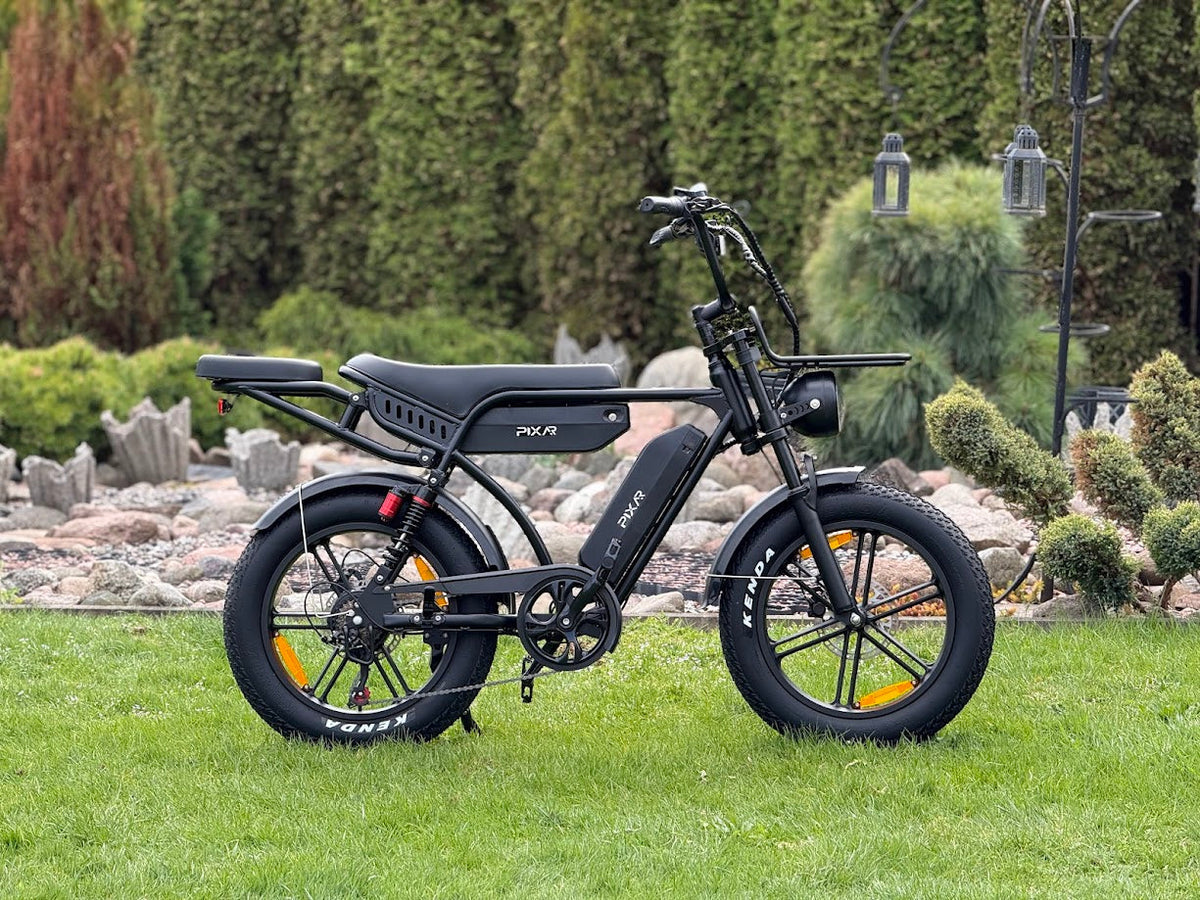
| PIXAR M9 | Shimano 7-speed, 14–28T | Seven rider gears in a high-capacity fat-tyre setup with 60 Nm and dual batteries |
C1 and C1 Pro use the same 7-speed range, while differing in battery and brakes. Largo pairs its 9-speed Shimano CUES drivetrain with a torque sensor, a current 55 Nm specification and a touring-focused format. M9 combines seven rider gears with higher torque, fat tyres and dual batteries. These differences show why the right bike depends on the complete use case, not the largest gear count.


What should you check before choosing?
Start with your regular route and answer four practical questions:
- Is the easiest gear comfortable on your longest regular climb?
- Do the steps between gears let you maintain a natural pedalling rhythm?
- Can you operate the shifter easily and shift smoothly under light pedal pressure?
- Do the motor, sensor, tyres, battery and bike fit match the same journey?
For mostly urban journeys, seven well-matched gears are a sensible choice. Consider nine when the additional ratios solve a real need on longer, hillier or more varied routes. Browse the current PIXAR electric bike range to compare gearing alongside the features that affect everyday riding.

Frequently asked questions
Do all electric bikes have gears?
No. Some electric bikes are single-speed, while others use derailleur or internal hub gears. Mechanical gears change your pedalling ratio; pedal-assist levels change the amount of motor support requested.
How many gears does an electric bike need?
Many city riders can use a 7-speed drivetrain comfortably. Nine or more ratios become useful when a route has longer climbs, frequent changes in gradient or mixed surfaces. The available gear range matters more than the count alone.
Is a 7-speed e-bike good for hills?
It can be suitable for moderate hills when the lowest ratio, motor support, total weight and rider effort match the route. Check the largest rear sprocket and test the actual climb rather than judging only from the number of gears.
Is a 9-speed e-bike faster than a 7-speed?
Not automatically. A 9-speed system provides more ratios, but top speed also depends on the complete gearing, wheel size, rider input, motor system and assistance limit. Extra gears mainly offer more choices for pedalling rhythm.
Should I change gear or assistance level on a hill?
Shift into an easier mechanical gear before the hill becomes steep, then select the lowest assistance level that provides the support you need. Gears manage your pedalling effort, while assistance controls requested motor help.
Can I change derailleur gears while the e-bike is stopped?
A conventional derailleur needs the chain to move, so it will not complete a normal shift while stationary. Select an easier gear before stopping, then pedal lightly while making any further change after you set off.