

If you are comparing a pedelec vs e-bike, first check how the motor works and how the vehicle is approved, not just its speed or price. Browse product options, then verify the exact model’s category before assuming where you can ride it.
A standard 250 W pedelec assists while you pedal and cuts assistance before 25 km/h; an S-pedelec can assist up to 45 km/h and is commonly treated as a moped. “E-bike” is often used loosely, so the label alone cannot tell you whether registration or cycle-path restrictions apply.
Why Pedelec vs E-Bike Is More Than Just Semantic Confusion
The pedelec vs e-bike distinction matters because “e-bike” is often an umbrella term, while laws classify vehicles by design, performance and approval. A product listing that says “electric bike” does not establish that it is legally a bicycle.
In the EU, Regulation (EU) No 168/2013 excludes a specific standard pedelec from vehicle type-approval rules: its maximum continuous rated motor power is no more than 250 W, assistance stops when the rider stops pedalling, and it progressively cuts out before 25 km/h.
A model outside those criteria is not automatically road-legal as a moped; its approval and local rules still matter.
Online listings may use “e-bike” for pedelecs, speed pedelecs and throttle-driven models. Before buying, ask for the vehicle’s legal category and approval documents. Do not infer road access from a photo, a wattage headline or the seller’s category name.

What Is the Real Difference Between Pedelec and E-Bike
The difference between pedelec and e-bike depends on propulsion and the legal criteria where you ride, not the marketing name. “Pedelec” usually means motor assistance is tied to pedalling; “e-bike” may refer to that or to other electric two-wheelers.
| Feature | Standard pedelec | S-pedelec | Throttle e-bike |
|---|---|---|---|
| Motor input | Assists while pedalling | Usually assists while pedalling | May propel without pedalling |
| Typical assisted speed | Up to 25 km/h | Up to 45 km/h | Varies by design and approval |
| Legal treatment | Bicycle if local criteria are met | Commonly moped or equivalent | Depends on design and approval |
| Check before riding | Power and cut-off | Approval and local obligations | Exact vehicle class and road approval |
A standard pedelec stops assisting when you stop pedalling and cuts assistance at its speed limit; you can continue under your own power. Some models have a low-speed walk-assist control.
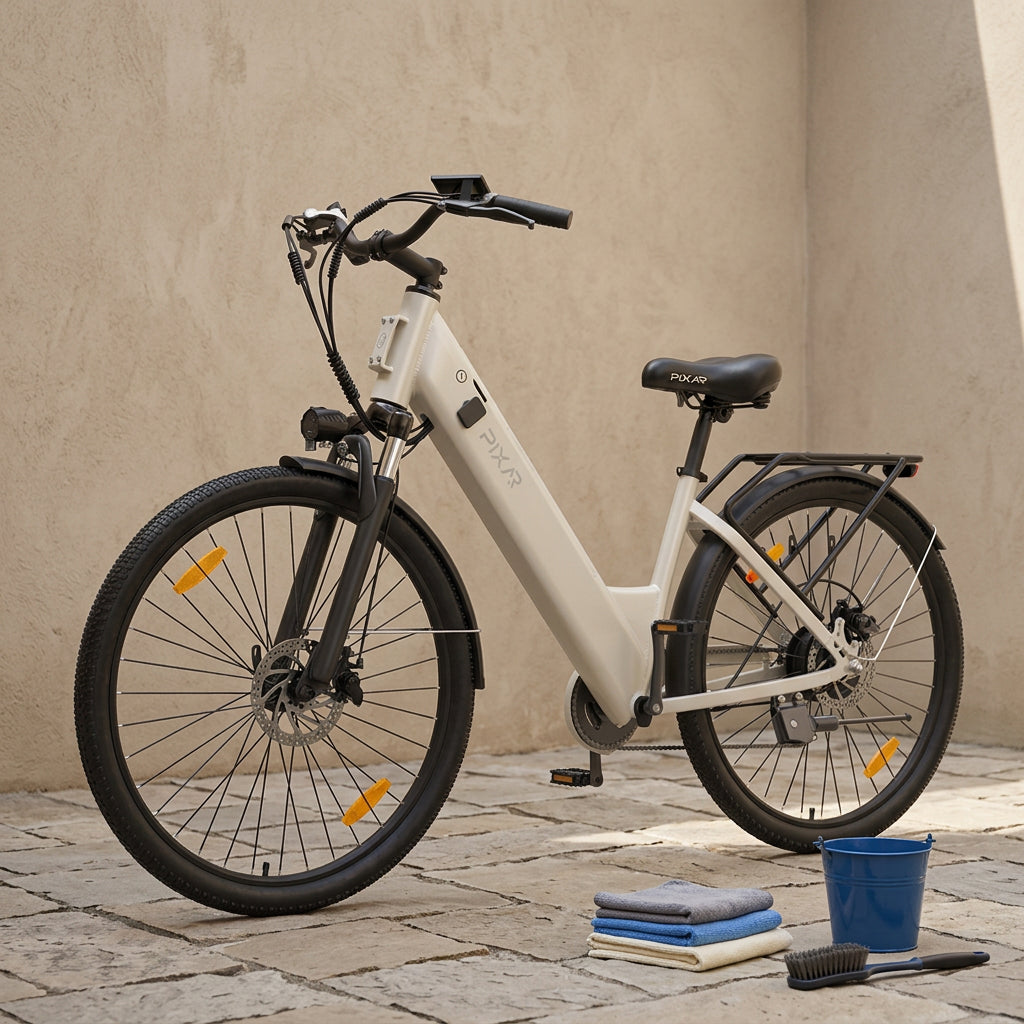
The PIXAR C1 has a 250 W motor, five pedal-assist levels and support up to 25 km/h. Its specifications illustrate the comparison point; confirm the exact vehicle approval and local rules before relying on a product listing to determine legal class.
Whether other throttle functions are permitted depends on the country and vehicle approval. A throttle is a reason to check the documents, not enough information to determine the legal class by itself.

Pedal Assist vs Throttle Mechanics and Sensor Technology
Pedal assist vs throttle describes how a rider requests motor power. Pedal-assist sensors detect crank movement or rider effort; a throttle can request power through a hand control, subject to the vehicle’s design and legal limits.
A cadence sensor in a pedal-assist system detects that the cranks are turning and activates assistance. A torque sensor measures how hard the rider pushes and can vary assistance with that effort. The sensor type affects the feel, but does not prove legal compliance or make one system universally better; tuning, assistance level and rider preference matter too.
For more on how the sensor, controller and motor work together, read How Pedal Assist Works on an Electric Bike.
When comparing pedal assist and throttle control for a commute, assess how predictably the bike starts, slows and responds at low speed. Try the controls in a safe setting, check when assistance stops, and confirm you can brake and steer comfortably.
Battery use cannot be reduced to a universal “Wh per kilometre” comparison: speed, terrain, load, rider input and assistance level all change consumption.
Pedelec vs S-Pedelec Speed Thresholds and Motor Performance
The pedelec vs s-pedelec comparison starts with the assistance cut-off: a standard pedelec stops assisting before 25 km/h, while an S-pedelec can assist up to 45 km/h. This difference can change the vehicle’s approval category and where it may be ridden.
In the pedelec vs S-pedelec comparison, kinetic energy rises with the square of speed. At 45 km/h, it is about 3.24 times the energy at 25 km/h. That does not mean stopping distance is always 3.24 times longer: brakes, tyres, road surface, weather, load and reaction time all affect it.
PIXAR’s electric bike speed guide explains what the 25 km/h cut-off means in everyday riding.
Treat an S-pedelec as the approved vehicle it is, not as a standard bicycle with a faster setting. Check the exact model’s approval, maximum design speed, required equipment and compatible replacement parts.
Then test whether the riding position and handling feel manageable at the speeds you expect to use. A higher top speed adds little if the route requires frequent stops or does not allow you to use it legally.
Navigating S-Pedelec Legal Requirements and Registration Duties
S-pedelec legal requirements vary by country. Do not assume Europe has one shared package of licence, registration, insurance and helmet rules. An S-pedelec commonly assists up to 45 km/h, but the vehicle’s type-approval documents identify its approved class.
Before purchase, request the Certificate of Conformity (CoC) or equivalent paperwork. Then confirm these requirements with the national road authority:
- Registration and insurance: whether the model needs a plate and third-party cover.
- Rider eligibility: minimum age and driving-licence category.
- Helmet and equipment: which helmet standard and vehicle equipment are required.
NTA 8776 is associated with speed-pedelec helmets, but do not assume it is mandatory in every country.
If a seller cannot provide approval documents, ask the registration authority whether that exact model and variant can be registered before buying. For broader licensing, insurance and commute trade-offs, see PIXAR’s E-Bike vs Moped guide.

Cycle Path Access and Child Trailer Restrictions
Cycle-path access and child-trailer rules depend on national law and local signs, so an e-bike label cannot answer either question. A pedelec that qualifies as a bicycle generally follows bicycle access rules; an S-pedelec treated as a moped may have to use the road instead. Check signs for the specific route, including shared paths and pedestrian areas.
If your commute depends on separated cycle tracks, map a legal road alternative before choosing a speed pedelec. A short route can become impractical if the vehicle cannot use the cycle infrastructure that makes it convenient.
Check child-seat and trailer rules separately. An attachment that fits mechanically is not necessarily permitted on every vehicle class. Germany’s Road Traffic Regulations allow certain child transport on bicycles under stated conditions.
Do not generalize those provisions to all S-pedelecs or other European countries. Confirm the vehicle, attachment and intended use with your local authority.
Choosing Between a Pedelec and an E-Bike for Daily Urban Commutes
The pedelec vs e-bike choice for commuting starts with route conditions, not the highest advertised speed. On short, stop-start urban trips, a standard pedelec may be simpler if its bicycle classification gives you access to the routes and storage you need.
For a journey under roughly 12 km, compare door-to-door time: junctions, crossings, parking and carrying the bike indoors can matter more than top speed. If your pedelec can use a direct cycle route, a faster vehicle may save little time in dense traffic.
An S-pedelec may suit a longer suburban corridor when the legal road route is practical and you are willing to meet the local licence, insurance, registration and helmet rules. Estimate the trip using realistic speeds and stops; a 45 km/h capability does not mean the whole journey averages that speed.
If the road route feels unsafe or inconvenient, the speed advantage may not compensate.
Before deciding, list distance, stop frequency, path access, road conditions, parking, charging and child-carrying needs. Then compare approved models against the whole trip. For another route-based comparison, see PIXAR’s guide to city and trekking e-bikes.
Pedelec vs E-Bike: Checks Before You Buy
Use the pedelec vs e-bike distinction as a document check, not a guess from the product photo. Ask the seller these questions before ordering:
- What is the approved vehicle category? Request the CoC or equivalent and check that the make, model and variant match.
- What are the rated power and cut-off? Compare continuous rated power and motor behaviour with your country’s pedelec criteria.
- Can a throttle propel it without pedalling? Ask which functions are included in the vehicle’s approval.
- What rules apply on your route? Confirm registration, insurance, licence, age, helmet, cycle-path and trailer requirements locally.
- What will ownership cost? Compare purchase price, any insurance or registration fees, charging, servicing, tyres, brakes and drivetrain wear. Get local quotes instead of relying on Europe-wide cost estimates.
For a standard pedelec, check that the frame markings and documents identify the vehicle and its compliance information. For an S-pedelec, prioritize its approval and registration paperwork. If documents conflict with the listing, resolve the discrepancy with the seller and registration authority before using it on public roads.
Final Words
Pedelecs, S-pedelecs and throttle e-bikes can look similar, but their motor behaviour and legal class may create very different obligations. Verify the documents and check the rules where you will ride, then match the approved category to your route.
A standard pedelec is often simpler when bicycle access matters; an S-pedelec can suit a longer road commute when its added requirements work for you. Before buying anything called an “e-bike,” confirm what it is legally approved to be.
Frequently Asked Questions
Do I need insurance and a plate for a pedelec?
A standard pedelec that meets local bicycle criteria generally does not need motor-vehicle registration or a plate. Confirm the exact category with your national road authority.
Can you ride an S-pedelec on a cycle path?
Rules depend on the country and path. Where an S-pedelec is treated as a moped, ordinary cycle paths may be off limits unless rules or signs allow it.
Can a pedelec have a throttle?
Some models have limited walk-assist, and local rules may recognize other approved throttle functions. Check the vehicle approval and national law.
Is an NTA 8776 helmet required for an S-pedelec?
Helmet standards vary by country. Check the rule for your vehicle category and where you ride.